

Playfulness is a more important consideration than play. The former is an attitude of mind; the latter is a passing outward manifestation of this attitude. When things are treated simply as vehicles of suggestion, what is suggested overrides the thing. Hence the playful attitude is one of freedom. The person is not bound to the physical traits of things, nor does he care whether a thing really means (as we say) what he takes it to represent. When the child plays horse with a broom and cars with chairs, the fact that the broom does not really represent a horse, or a chair a locomotive, is of no account. In order, then, that playfulness may not terminate in arbitrary fancifulness and in building up an imaginary world alongside the world of actual things, it is necessary that the play attitude should gradually pass into a work attitude.
— John Dewey, How We Think.
Editing poetry is some real annoying shit. You stare at the page, hoping your general dissatisfaction with yourself, your life, and your work will cooperate and take on some specific form. Once you lock onto and blow away the garbage holding the poem back, you have to hope your brain switches from critic mode back to writer mode and thinks of something, anything good enough to replace the junk you just eliminated. I am always on the lookout for “one weird trick” that will make this process less excrutiating.
Apropos of nothing, I read Georgi Gardiner’s “Purism and Pluralism: On the Brilliance of Tarot and the Breadth of Epistemology” today. It is very much a “collected volume” essay: an opportunity for an academic to get a pet subject out of their system in an academically-shaped essay that would not cut it in a demanding journal. I say this without abuse, this is my preferred genre of academic essays.
To offer a precis: having evolved from game pieces to diviner’s medium, in recent decades Tarot has changed again into a meditative, introspective practice. In this introspective use, the practitioner brings a question to mind, meditating on that question. They deal one or more cards from the deck in a “spread.” By convention, the cards have specific (but ambiguous) symbolic meanings. The positions in the spread may also have conventional meanings, relating to some aspect of the question. This broadness of meaning results in the card suggesting an avenue of mental exploration without predetermining the results.
Gardiner describes this as a form of “epistemic play,” the cards suggest possible perspectives without demaning them. The interpretive work of exploring the image generates new resources that can be brought to bear on the question at hand. I quoted Dewey up front as there’s a kinship here with his account of how play becomes work: the child begins with an attitude of playfulness, dwelling among concepts, but gradually finds ways to reimpose the concreteness of the materials of their play and to form objectives around those materials. With Tarot as Gardiner describes it, that work remains at the cognitive level; it motivates the play but is partially bracketed and reemerges as play progresses.
We may glance over the full account of the epistemic virtues Gardiner thinks accrue to Tarot in favor of giving it a go ourselves. Since I don’t own a Tarot deck, I found one online and pulled a spread of six cards while meditating on the question “Why do I find Tarot cringe?” The first card was The Fool; I immediately exited the tab.
Critical self-knowledge is one of benefits Gardiner thinks the practitioner of Tarot can reap. Perhaps the cards were trying to tell me that I was the cringe one, snob that I am. Maybe so. But I realized that what I find unappealing is not the act of drawing and spreading cards while thinking of a question—that’s rad, actually—but the conventional symbolism of the cards. (A prejudice I hold to much more broadly, e.g. against flower symbolism.)
So a few prompts later I had my own “Tarot” web app with a Breugel set of cards.
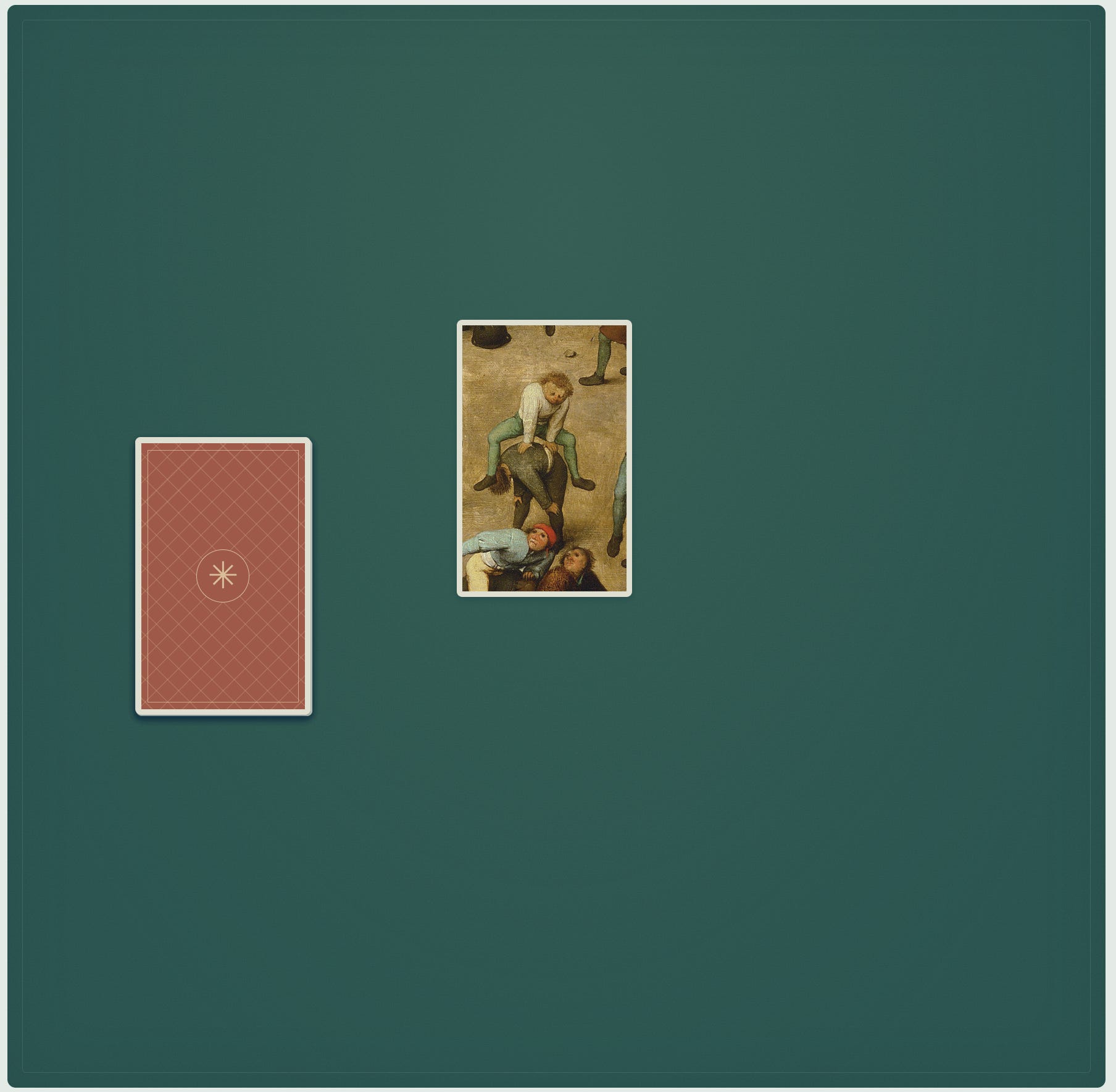
What to do with this? Well, in addition to this little series of small essays I’m attempting for November, I’ve been writing and revising a poem every day. I pick the draft to revise randomly, and today’s luck of the draw brought up this lil guy.
Milk Carton
Check your child’s face against each missing poster: more and more people are becoming kidnappers by accident. There are other signs: a spoon angled against a bowl in such a way as to express exasperation with the world, cat treats spread like clues in a murder scene behind the television console, silences that lay around like unsorted socks. When your child walks into the kitchen in one of those movements redolent with a secret purpose and looks out the window, note the position of the planets. If Venus is ascendent, there is a boulder on Whitetop with wet moss patterned into an escape plan. He is already practicing how to say “I love you” like a presidential assassination.
As a rule, I find there are two questions that are helpful to ask in revising a poem. “What is not contributing to what this poem is doing?” and “What should the poem be talking about but isn’t?” For myself, especially in early drafts, as this poem is, the second question is more important than the first. It’s too easy to arrive at a result that is “polished” but empty by focusing too much or too early on finish. So, armed with a question and a deck to draw answers from, I shuffled the deck and was rewarded with this detail from Pieter Breugel’s Children’s Games. (Fitting for the draft; to be fair the odds were good as I’d only loaded in cards from 3 paintings.) After contemplating the card for a while, the curious contrast between the boy being leapfrogged, his gaze forced to the earth, and the children beneath, eyes up as if to the Rapture, I wrote the following revision.
Milk Carton

Check each missing person poster against your child's face.
Have you said? There were those two girls on CitiBikes
the truck full stopped. Something must be done
about the arrangement of the planets, the catch-breath

of the prams racing like train cars to the chambers.
Have we thought for a moment about what we are doing?
The spoon clatters against its empty bowl. There was a terrible racket
of bells the whole period in which Notre Dame burned.

During the birth, you felt a need to face the sky
as if the infant might fall upwards into its carrying.
The immortal things are vaporous and voidful, they
contain and contain. There are many versions of the story

in which Thetis washes out the boy's givenness
to death and six robin eggs, and the robin herself.
A masterpiece and a validation of the power of the cards? Surely not (I would not be posting this on Substack if I thought it was). But an interesting experience and an approach I intend to keep playing around with.